'%3e%3cg%20filter='url(%23filter0_i_679_862)'%3e%3ccircle%20cx='47.3083'%20cy='88.4997'%20r='11.3083'%20fill='url(%23paint0_radial_679_862)'/%3e%3c/g%3e%3ccircle%20cx='50.0719'%20cy='91.9742'%20r='4.025'%20fill='%231B1B1B'/%3e%3cg%20style='mix-blend-mode:color-dodge'%3e%3ccircle%20cx='47.3893'%20cy='90.0612'%20r='1.91667'%20fill='%23D9D9D9'/%3e%3c/g%3e%3c/g%3e%3cg%20clip-path='url(%23clip1_679_862)'%3e%3cg%20filter='url(%23filter1_i_679_862)'%3e%3ccircle%20cx='81.6443'%20cy='88.4997'%20r='11.3083'%20fill='url(%23paint1_radial_679_862)'/%3e%3c/g%3e%3ccircle%20cx='84.4039'%20cy='91.9742'%20r='4.025'%20fill='%231B1B1B'/%3e%3cg%20style='mix-blend-mode:color-dodge'%3e%3ccircle%20cx='81.7214'%20cy='90.0612'%20r='1.91667'%20fill='%23D9D9D9'/%3e%3c/g%3e%3c/g%3e%3cdefs%3e%3cfilter%20id='filter0_i_679_862'%20x='36'%20y='75.1711'%20width='23.6273'%20height='24.6375'%20filterUnits='userSpaceOnUse'%20color-interpolation-filters='sRGB'%3e%3cfeFlood%20flood-opacity='0'%20result='BackgroundImageFix'/%3e%3cfeBlend%20mode='normal'%20in='SourceGraphic'%20in2='BackgroundImageFix'%20result='shape'/%3e%3cfeColorMatrix%20in='SourceAlpha'%20type='matrix'%20values='0%200%200%200%200%200%200%200%200%200%200%200%200%200%200%200%200%200%20127%200'%20result='hardAlpha'/%3e%3cfeOffset%20dx='1.01015'%20dy='-2.02031'/%3e%3cfeGaussianBlur%20stdDeviation='1.01015'/%3e%3cfeComposite%20in2='hardAlpha'%20operator='arithmetic'%20k2='-1'%20k3='1'/%3e%3cfeColorMatrix%20type='matrix'%20values='0%200%200%200%200%200%200%200%200%200%200%200%200%200%200%200%200%200%200.15%200'/%3e%3cfeBlend%20mode='normal'%20in2='shape'%20result='effect1_innerShadow_679_862'/%3e%3c/filter%3e%3cfilter%20id='filter1_i_679_862'%20x='70.3359'%20y='75.1711'%20width='23.6273'%20height='24.6375'%20filterUnits='userSpaceOnUse'%20color-interpolation-filters='sRGB'%3e%3cfeFlood%20flood-opacity='0'%20result='BackgroundImageFix'/%3e%3cfeBlend%20mode='normal'%20in='SourceGraphic'%20in2='BackgroundImageFix'%20result='shape'/%3e%3cfeColorMatrix%20in='SourceAlpha'%20type='matrix'%20values='0%200%200%200%200%200%200%200%200%200%200%200%200%200%200%200%200%200%20127%200'%20result='hardAlpha'/%3e%3cfeOffset%20dx='1.01015'%20dy='-2.02031'/%3e%3cfeGaussianBlur%20stdDeviation='1.01015'/%3e%3cfeComposite%20in2='hardAlpha'%20operator='arithmetic'%20k2='-1'%20k3='1'/%3e%3cfeColorMatrix%20type='matrix'%20values='0%200%200%200%200%200%200%200%200%200%200%200%200%200%200%200%200%200%200.15%200'/%3e%3cfeBlend%20mode='normal'%20in2='shape'%20result='effect1_innerShadow_679_862'/%3e%3c/filter%3e%3cradialGradient%20id='paint0_radial_679_862'%20cx='0'%20cy='0'%20r='1'%20gradientUnits='userSpaceOnUse'%20gradientTransform='translate(47.3083%2088.4997)%20rotate(29.2803)%20scale(11.9552)'%3e%3cstop%20offset='0.634615'%20stop-color='white'/%3e%3cstop%20offset='1'%20stop-color='%23A8FFEA'/%3e%3c/radialGradient%3e%3cradialGradient%20id='paint1_radial_679_862'%20cx='0'%20cy='0'%20r='1'%20gradientUnits='userSpaceOnUse'%20gradientTransform='translate(81.6443%2088.4997)%20rotate(29.2803)%20scale(11.9552)'%3e%3cstop%20offset='0.634615'%20stop-color='white'/%3e%3cstop%20offset='1'%20stop-color='%23A8FFEA'/%3e%3c/radialGradient%3e%3cclipPath%20id='clip0_679_862'%3e%3crect%20width='22.6167'%20height='22.6167'%20fill='white'%20transform='translate(36%2077.1914)'/%3e%3c/clipPath%3e%3cclipPath%20id='clip1_679_862'%3e%3crect%20width='22.6167'%20height='22.6167'%20fill='white'%20transform='translate(70.3359%2077.1914)'/%3e%3c/clipPath%3e%3c/defs%3e%3c/svg%3e)

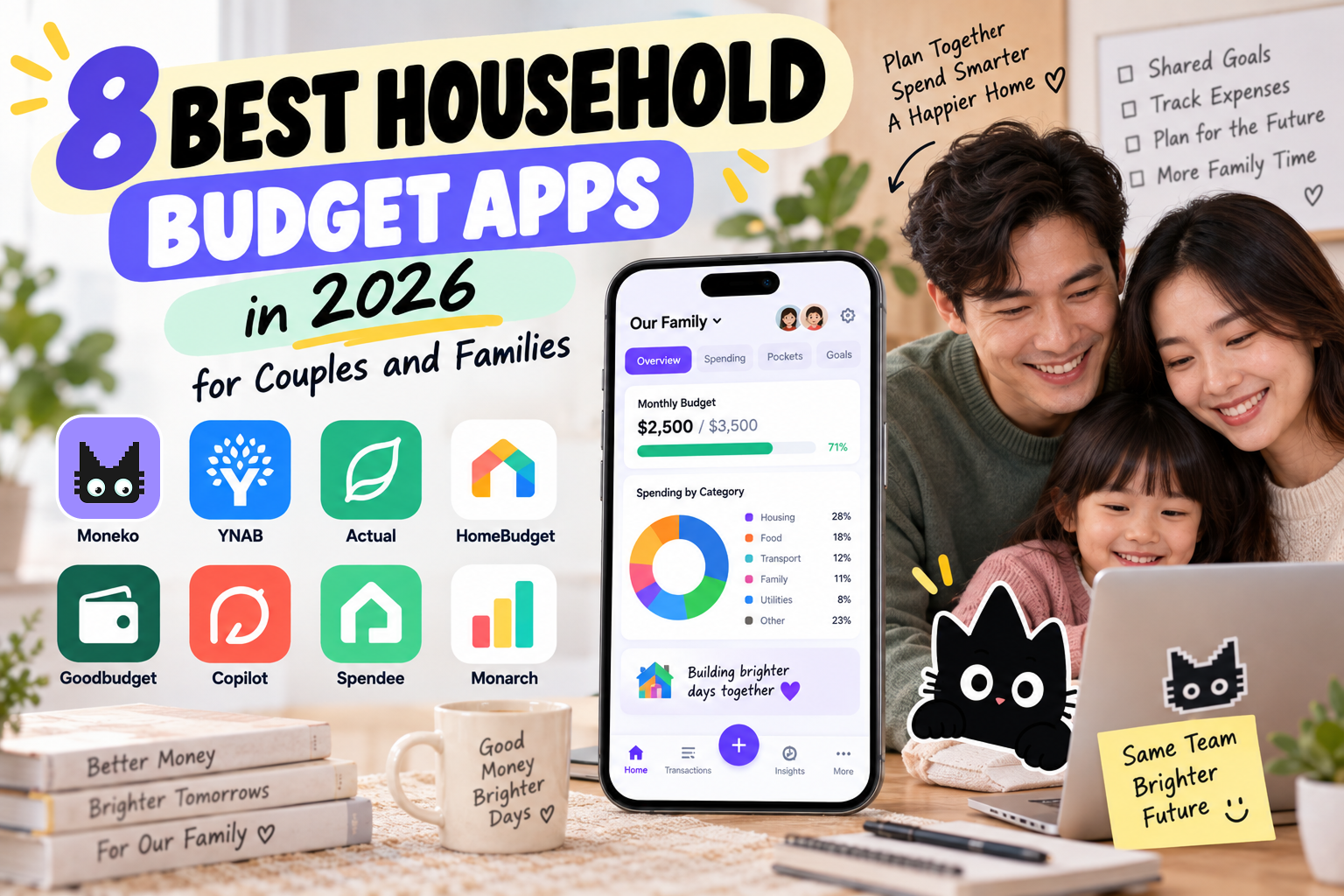
Managing a household budget gets complicated quickly. You pay rent, your partner buys groceries, utilities come from a joint account, subscriptions hit separate cards, and somewhere along the way someone asks, “Did I pay for dinner last time?”
A good household budget app needs to do more than track spending. Both people need an easy way to contribute, shared expenses need to stay separate from personal spending, and recurring bills shouldn't require the same work every month.
We compared eight popular household budgeting apps based on how well they handle these everyday problems.
Best Household Budget Apps at a Glance
| App | Best For | Shared Budget | Expense Splitting | Free Option |
|---|---|---|---|---|
| Moneko AI | Everyday household budgeting | Yes | Yes | Yes |
| Monarch Money | Complete financial overview | Yes | Limited | Trial |
| YNAB | Zero-based budgeting | Yes | Limited | Trial |
| Goodbudget | Envelope budgeting | Yes | No | Yes |
| Honeydue | Couples with separate accounts | Yes | Yes | Yes |
| Splitwise | Tracking who owes whom | Limited | Yes | Yes |
| Lunch Money | Flexible expense tracking | Yes | Limited | Trial |
| Google Sheets | DIY household budgeting | Manual | Manual | Yes |
How We Chose the Best Household Budget Apps
A good personal budgeting app doesn't automatically work well for a household. Once two or more people manage money together, the questions change.
Does everyone have their own access? Do personal purchases stay private? Who records groceries? What happens when one person pays more? How are rent, utilities, subscriptions, and other recurring costs handled?
We focused on shared budgeting, expense tracking, recurring bills, collaboration, automation, and ease of use. We also considered maintenance because a household budget only works when everyone keeps using the system.
1. Moneko AI: Best Overall for Everyday Household Budgeting
Best for: Couples, families, and roommates who want shared budgeting and expense management in one place.
Many household finance apps solve one side of the problem. Budgeting apps help you decide how much to spend. Bill-splitting apps calculate who owes whom. Moneko brings both into the same household system.
Suppose you pay $120 for groceries while your partner covers the $70 internet bill. Both purchases go into your shared Space, where you track household spending and splits together. Personal purchases stay in your own Space instead of getting mixed into the household budget.
Expense entry is designed around everyday use too. Type “Groceries $120,” record the purchase by voice, scan a receipt, or send an expense through WhatsApp or Telegram. AI helps categorize the transaction, while recurring expenses handle regular costs such as rent, internet, insurance, and subscriptions.
This approach works especially well in households where one person usually ends up maintaining the budget for everyone else.
Why We Picked Moneko
Moneko combines several tasks households often manage separately: budgeting, expense tracking, bill splitting, recurring expenses, and personal spending.
Instead of maintaining one app for budgeting and another for reimbursements, both sides of household money management live together.
What We Like
- Shared household budgets
- Personal and shared Spaces
- Bill splitting
- AI expense categorization
- WhatsApp and Telegram expense capture
- Voice expense logging
- Receipt scanning
- Recurring expenses
- Spending insights
- Multi-currency support
Things to Consider
If connecting financial accounts and monitoring investments are your highest priorities, Monarch Money offers a more established financial aggregation experience.
Who Should Choose Moneko?
Choose Moneko if your household wants to actively manage everyday spending together while keeping personal and shared finances organized separately.
2. Monarch Money: Best for Seeing Your Entire Household Finances
Best for: Couples and families with multiple financial accounts, investments, and savings goals.
Monarch Money takes a broader view of household finances. Instead of focusing primarily on daily expense management, you connect accounts and see spending, cash flow, investments, net worth, and financial goals from one dashboard.
For a household with checking accounts, credit cards, retirement accounts, investments, and several savings goals, having everything together makes financial reviews easier.
The trade-off is complexity and price. If your main concern is managing groceries, household bills, and shared spending, much of Monarch's broader financial functionality might go unused.
Choose Monarch Money if seeing your complete financial picture matters more than bill splitting or lightweight everyday expense entry.
3. YNAB: Best for Families Who Want to Plan Every Dollar
Best for: Households committed to zero-based budgeting.
YNAB starts before the money gets spent. You take the money currently available and assign it to priorities such as housing, groceries, transportation, childcare, savings, and entertainment.
A monthly household plan might look like:
Housing: $1,800
Groceries: $700
Transportation: $250
Children's activities: $200
Emergency savings: $500
This structure gives families clear spending boundaries and encourages decisions before purchases happen rather than reviewing spending afterward.
The trade-off is maintenance. Everyone involved needs to understand the budgeting method and keep the plan current. For households willing to put in the work, YNAB offers one of the strongest structured budgeting systems available.
Choose YNAB if your family wants a defined budgeting methodology rather than a lighter expense-management system.
4. Goodbudget: Best for Digital Envelope Budgeting
Best for: Families who prefer traditional envelope budgeting.
Goodbudget turns the cash-envelope method into a digital household budget. You divide available money between categories such as groceries, transportation, entertainment, household purchases, and savings.
If your grocery envelope has $600 for the month, every grocery purchase reduces the amount left. This gives everyone a clear spending boundary without requiring a complicated financial dashboard.
Goodbudget also supports sharing across devices, which makes the same envelope budget accessible to household members.
Its biggest trade-off is manual maintenance. If Saturday's $140 grocery trip never gets recorded, your grocery envelope no longer reflects reality.
Choose Goodbudget if your household likes clear spending limits and doesn't mind entering expenses manually.
5. Honeydue: Best for Couples With Separate Accounts
Best for: Couples who want financial visibility without combining everything.
Not every couple wants fully merged finances. You might split rent and groceries while keeping your personal checking accounts, credit cards, and discretionary spending separate.
Honeydue is designed around this arrangement. Partners decide how much financial information to share while maintaining a joint view of the household activity they want to manage together.
This makes Honeydue particularly useful for couples following a “mine, yours, ours” approach. Its budgeting features are lighter than a system such as YNAB, but account visibility is the bigger reason to use Honeydue.
Choose Honeydue if sharing selected financial information matters more than maintaining a detailed shared budget.
6. Splitwise: Best for Roommates Who Need to Know Who Owes What
Best for: Roommates and households focused on reimbursements.
Splitwise solves a narrower problem.
Your roommate pays the $120 electricity bill. You spend $75 on household supplies. Someone else pays $60 for internet. Splitwise keeps track of those payments and calculates who owes whom.
For roommates, this often solves the biggest shared-money headache without requiring everyone to maintain a household budget.
Where Splitwise falls short is planning. Knowing your roommate owes you $45 doesn't tell you whether the household spent too much on groceries this month or how much everyone should set aside for next month's expenses.
Choose Splitwise if settling balances matters more than budgeting.
7. Lunch Money: Best for Flexible Household Expense Tracking
Best for: Households that want detailed tracking without following a strict budgeting method.
Some families want to understand their spending without assigning every dollar to an envelope or category before the month starts.
Lunch Money fits this middle ground. It offers transaction categorization, budgets, recurring expenses, and detailed spending analysis while leaving more flexibility around how you structure your finances.
This makes Lunch Money useful for households that enjoy reviewing spending data but don't want their budgeting app to dictate a specific methodology.
Choose Lunch Money if flexibility and financial analysis matter more than bill splitting or a strict budgeting system.
8. Google Sheets: Best Free DIY Household Budget
Best for: Families comfortable maintaining their own system.
A spreadsheet still works surprisingly well for many households. You decide which categories exist, what gets shared, how expenses are split, and which numbers matter.
A simple household spreadsheet might include income, rent, groceries, utilities, subscriptions, transportation, childcare, savings, and personal spending. Both partners update the same document throughout the month.
The problem appears when nobody wants to maintain it. Someone has to enter purchases, update recurring expenses, check formulas, and remind everyone else to keep the spreadsheet current.
Choose Google Sheets if customization matters more than automation and your household already has a reliable budgeting routine.
What Should You Look for in a Household Budget App?
Everyone Should Be Able to Participate
If one person needs to record every grocery purchase, utility payment, and household expense, the budgeting system quickly becomes another unpaid household job.
Look for separate access for each household member and a simple expense-entry process. The less explanation required to get everyone participating, the easier the budget is to maintain.
Personal and Shared Money Should Stay Separate
Sharing rent doesn't mean sharing every purchase.
Many couples keep some combination of personal and shared finances. Your household budgeting system should reflect this without forcing every coffee, gift, hobby purchase, or personal subscription into the family budget.
This becomes especially important for couples who maintain separate bank accounts while contributing toward shared expenses.
Recurring Bills Shouldn't Start From Zero Every Month
Rent, mortgages, internet, insurance, childcare, subscriptions, and utilities return month after month.
A household budget should keep those obligations visible without asking someone to recreate the same expenses every payday.
Expense Entry Needs to Be Easy
Even the most detailed household budget becomes useless when nobody keeps it updated.
Different apps solve this in different ways. Bank syncing imports transactions automatically. Receipt scanning reduces typing. Voice entry lets you record spending quickly. Messaging integrations such as WhatsApp and Telegram let you log expenses from conversations you already use.
The right method is whichever one your household consistently follows.
Frequently Asked Questions
What is the best household budget app in 2026?
Moneko is a strong choice for households that want shared budgets, bill splitting, recurring expenses, and AI-assisted expense tracking together. YNAB suits families committed to zero-based budgeting, while Monarch Money works better for households seeking a broader view of accounts, investments, cash flow, and financial goals.
What is the best free household budget app?
Moneko and Goodbudget offer free options for household budgeting. Google Sheets is another free choice if you're comfortable building and maintaining the budget manually. Free-plan features change over time, so check current limits before choosing a service.
What is the best household budget app for couples?
Moneko fits couples who actively manage shared spending and household budgets together while keeping personal finances separate. Honeydue is worth considering when selective account visibility and separate finances are the bigger priorities.
What is the best budget app for couples with separate accounts?
Honeydue focuses specifically on couples who want financial visibility while maintaining separate accounts. Moneko is a stronger fit when the priority is maintaining separate personal budgets alongside a shared household budget.
Do couples need a joint bank account to budget together?
No. A household budget doesn't require fully merged finances. Couples often keep personal accounts while deciding which expenses, such as rent, groceries, utilities, childcare, and household purchases, belong in their shared budget.
What is the best household budget app for roommates?
Splitwise works well if your main concern is reimbursements and tracking who owes whom. Moneko is a better fit if roommates also want a shared household budget, recurring bills, expense tracking, and monthly spending insights.
Is a household budget app better than a spreadsheet?
A spreadsheet gives you more control and costs nothing, but someone needs to maintain it. A dedicated household budgeting app reduces manual work through features such as recurring expenses, transaction imports, receipt scanning, shared access, and automatic categorization.
Final Verdict
The best household budget app depends on how your family manages money.
YNAB and Goodbudget suit households that want a structured budgeting method. Monarch Money works well when your priority is seeing accounts, investments, spending, and goals together. Honeydue fits couples with separate accounts, while Splitwise keeps roommate reimbursements straightforward.
Moneko fills the space between budgeting and shared expense management. You keep personal spending separate, manage household expenses together, split bills, track recurring costs, and record purchases through text, voice, receipts, WhatsApp, or Telegram.
For most households, the deciding factor isn't which app has the most features. It's whether everyone will still use the system three months from now.
