'%3e%3cg%20filter='url(%23filter0_i_679_862)'%3e%3ccircle%20cx='47.3083'%20cy='88.4997'%20r='11.3083'%20fill='url(%23paint0_radial_679_862)'/%3e%3c/g%3e%3ccircle%20cx='50.0719'%20cy='91.9742'%20r='4.025'%20fill='%231B1B1B'/%3e%3cg%20style='mix-blend-mode:color-dodge'%3e%3ccircle%20cx='47.3893'%20cy='90.0612'%20r='1.91667'%20fill='%23D9D9D9'/%3e%3c/g%3e%3c/g%3e%3cg%20clip-path='url(%23clip1_679_862)'%3e%3cg%20filter='url(%23filter1_i_679_862)'%3e%3ccircle%20cx='81.6443'%20cy='88.4997'%20r='11.3083'%20fill='url(%23paint1_radial_679_862)'/%3e%3c/g%3e%3ccircle%20cx='84.4039'%20cy='91.9742'%20r='4.025'%20fill='%231B1B1B'/%3e%3cg%20style='mix-blend-mode:color-dodge'%3e%3ccircle%20cx='81.7214'%20cy='90.0612'%20r='1.91667'%20fill='%23D9D9D9'/%3e%3c/g%3e%3c/g%3e%3cdefs%3e%3cfilter%20id='filter0_i_679_862'%20x='36'%20y='75.1711'%20width='23.6273'%20height='24.6375'%20filterUnits='userSpaceOnUse'%20color-interpolation-filters='sRGB'%3e%3cfeFlood%20flood-opacity='0'%20result='BackgroundImageFix'/%3e%3cfeBlend%20mode='normal'%20in='SourceGraphic'%20in2='BackgroundImageFix'%20result='shape'/%3e%3cfeColorMatrix%20in='SourceAlpha'%20type='matrix'%20values='0%200%200%200%200%200%200%200%200%200%200%200%200%200%200%200%200%200%20127%200'%20result='hardAlpha'/%3e%3cfeOffset%20dx='1.01015'%20dy='-2.02031'/%3e%3cfeGaussianBlur%20stdDeviation='1.01015'/%3e%3cfeComposite%20in2='hardAlpha'%20operator='arithmetic'%20k2='-1'%20k3='1'/%3e%3cfeColorMatrix%20type='matrix'%20values='0%200%200%200%200%200%200%200%200%200%200%200%200%200%200%200%200%200%200.15%200'/%3e%3cfeBlend%20mode='normal'%20in2='shape'%20result='effect1_innerShadow_679_862'/%3e%3c/filter%3e%3cfilter%20id='filter1_i_679_862'%20x='70.3359'%20y='75.1711'%20width='23.6273'%20height='24.6375'%20filterUnits='userSpaceOnUse'%20color-interpolation-filters='sRGB'%3e%3cfeFlood%20flood-opacity='0'%20result='BackgroundImageFix'/%3e%3cfeBlend%20mode='normal'%20in='SourceGraphic'%20in2='BackgroundImageFix'%20result='shape'/%3e%3cfeColorMatrix%20in='SourceAlpha'%20type='matrix'%20values='0%200%200%200%200%200%200%200%200%200%200%200%200%200%200%200%200%200%20127%200'%20result='hardAlpha'/%3e%3cfeOffset%20dx='1.01015'%20dy='-2.02031'/%3e%3cfeGaussianBlur%20stdDeviation='1.01015'/%3e%3cfeComposite%20in2='hardAlpha'%20operator='arithmetic'%20k2='-1'%20k3='1'/%3e%3cfeColorMatrix%20type='matrix'%20values='0%200%200%200%200%200%200%200%200%200%200%200%200%200%200%200%200%200%200.15%200'/%3e%3cfeBlend%20mode='normal'%20in2='shape'%20result='effect1_innerShadow_679_862'/%3e%3c/filter%3e%3cradialGradient%20id='paint0_radial_679_862'%20cx='0'%20cy='0'%20r='1'%20gradientUnits='userSpaceOnUse'%20gradientTransform='translate(47.3083%2088.4997)%20rotate(29.2803)%20scale(11.9552)'%3e%3cstop%20offset='0.634615'%20stop-color='white'/%3e%3cstop%20offset='1'%20stop-color='%23A8FFEA'/%3e%3c/radialGradient%3e%3cradialGradient%20id='paint1_radial_679_862'%20cx='0'%20cy='0'%20r='1'%20gradientUnits='userSpaceOnUse'%20gradientTransform='translate(81.6443%2088.4997)%20rotate(29.2803)%20scale(11.9552)'%3e%3cstop%20offset='0.634615'%20stop-color='white'/%3e%3cstop%20offset='1'%20stop-color='%23A8FFEA'/%3e%3c/radialGradient%3e%3cclipPath%20id='clip0_679_862'%3e%3crect%20width='22.6167'%20height='22.6167'%20fill='white'%20transform='translate(36%2077.1914)'/%3e%3c/clipPath%3e%3cclipPath%20id='clip1_679_862'%3e%3crect%20width='22.6167'%20height='22.6167'%20fill='white'%20transform='translate(70.3359%2077.1914)'/%3e%3c/clipPath%3e%3c/defs%3e%3c/svg%3e)

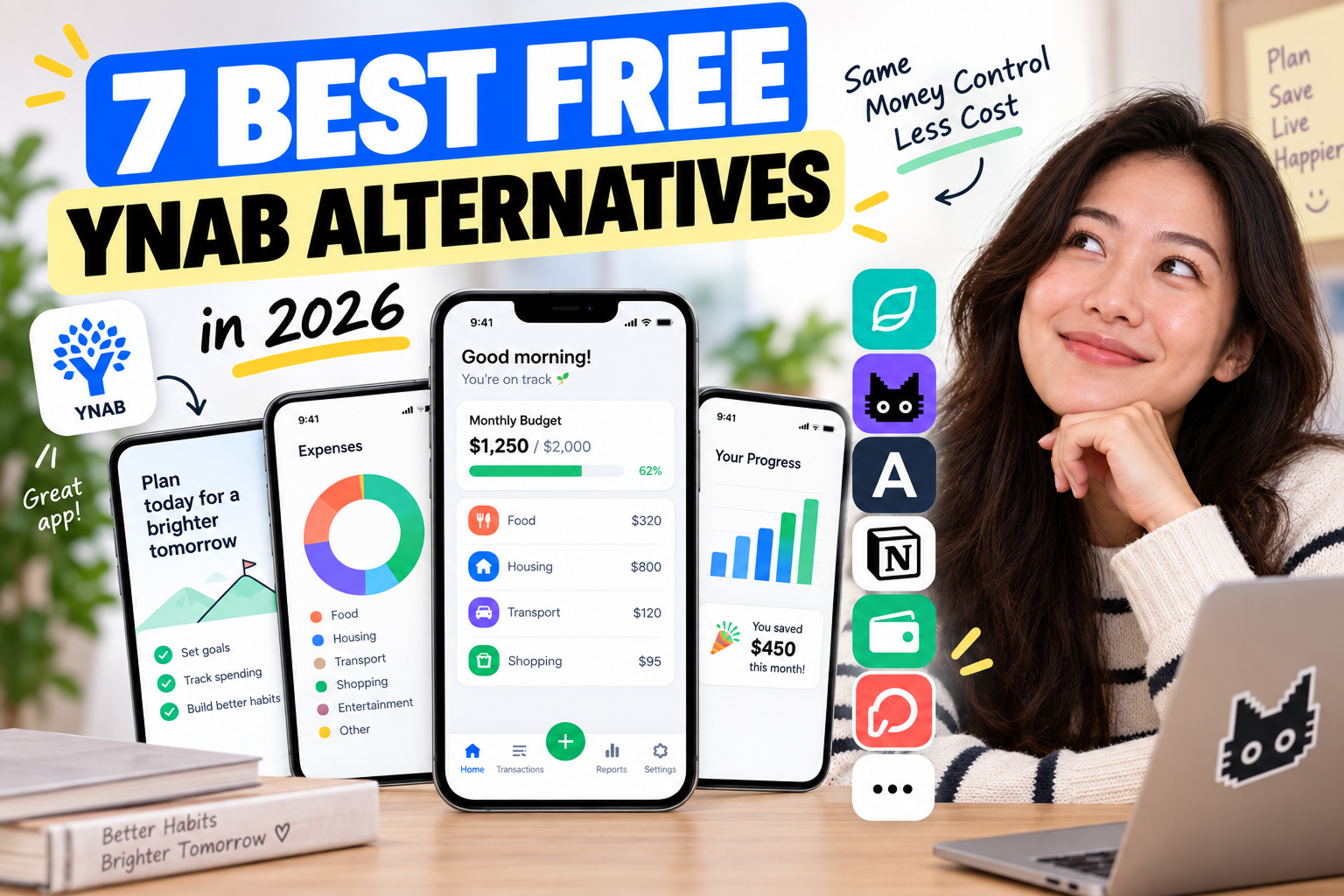
YNAB is a good budgeting system if you enjoy actively planning where every dollar goes. The problem is the commitment. YNAB costs $109 per year or $14.99 per month after its 34-day trial, and getting full value from the system means keeping your budget current.
If you're looking for a free YNAB alternative, first ask why you want to switch. If you like YNAB but dislike the subscription, Actual Budget is one of the closest replacements. If you're tired of categorizing transactions and maintaining a detailed budget, switching to another zero-based budgeting app might leave you with the same problem.
We compared seven alternatives covering both situations.
Best Free YNAB Alternatives at a Glance
| App | Best For | Free Option | Budgeting Style |
|---|---|---|---|
| Moneko AI | Easier budgeting + shared finances | Yes | Flexible |
| Actual Budget | Closest free YNAB alternative | Yes | Zero-based |
| Goodbudget | Envelope budgeting | Yes | Envelope |
| EveryDollar | Simple zero-based budgeting | Yes | Zero-based |
| Rocket Money | Spending + subscriptions | Yes | Spending tracking |
| Empower | Net worth + financial overview | Yes | Financial tracking |
| Google Sheets | Complete customization | Yes | DIY |
Why Are People Looking for YNAB Alternatives?
YNAB asks you to give the money you already have a job. Instead of spending first and reviewing later, you decide how much goes toward groceries, housing, transportation, savings, entertainment, and other priorities.
For people who enjoy active budgeting, this structure is YNAB's biggest strength. For people who constantly fall behind on categorizing transactions or reconciling accounts, the same structure starts feeling like work.
This creates two different searches for a YNAB alternative:
- “I like YNAB, but I don't want to pay $109 every year.”
- “I tried YNAB, but I don't want to spend this much time maintaining a budget.”
Those users shouldn't necessarily choose the same replacement.
1. Moneko AI: Best for Easier Everyday Budgeting
Best for: People who want less financial admin, especially couples, families, and roommates.
YNAB starts with planning. You assign your available money to categories before spending.
Moneko starts closer to everyday life. You buy groceries, split dinner with your partner, pay the internet bill, or renew a subscription, then record the expense through text, voice, a receipt photo, WhatsApp, or Telegram. AI helps organize spending afterward.
Suppose you spend $86 at the grocery store. Instead of opening your budget and completing several fields, you enter:
Groceries $86
Or if you're sharing the purchase:
Groceries $86 split with Alex
The expense becomes part of your spending history and shared finances. This approach fits people who still want a budget but don't want maintaining one to become a weekly project.
Why We Picked Moneko
Moneko solves a different problem from most YNAB alternatives. Instead of recreating YNAB for less money, Moneko reduces the work involved in keeping your financial picture current.
The difference becomes more noticeable for couples and households. Personal budgets, Shared Spaces, bill splitting, recurring expenses, and shared spending live together instead of requiring separate budgeting and expense-splitting apps.
What You Get
- Personal and shared budgets
- Shared Spaces
- AI expense categorization
- Text and voice expense logging
- Receipt scanning
- WhatsApp and Telegram expense capture
- Bill splitting
- Recurring expenses
- Spending insights
- Multi-currency tracking
Who Should Choose Moneko?
Choose Moneko if your biggest frustration with YNAB is maintenance rather than price.
Moneko also makes more sense if you manage money with a partner, roommate, or family and want budgeting and shared expenses in the same system.
If you love YNAB's methodology and only want to remove the subscription, Actual Budget is the stronger match.
2. Actual Budget: Closest Free Alternative to YNAB
Best for: YNAB users who want zero-based budgeting without the subscription.
Actual Budget should be near the top of your list if your main complaint about YNAB is price.
The open-source software follows an envelope-style budgeting approach centered on assigning money before spending. The core software is free when self-hosted, making Actual Budget one of the closest no-subscription replacements for YNAB.
The trade-off is setup. Self-hosting takes more technical effort than downloading a normal consumer budgeting app, and switching doesn't remove much of the hands-on budgeting work.
That's also why Actual Budget isn't automatically better for someone who finds YNAB exhausting. You save the subscription fee, but you still need to maintain the budget.
Who Should Choose Actual Budget?
Choose Actual Budget if you already like YNAB's budgeting philosophy and mainly want to stop paying the annual subscription.
3. Goodbudget: Best for Simple Envelope Budgeting
Best for: People who want spending boundaries without YNAB's full system.
Goodbudget takes traditional cash envelopes and turns them into digital spending categories. Put $500 into groceries, $150 into restaurants, and $200 into entertainment, then record purchases against each envelope.
This makes the budget easy to understand at a glance. If your grocery envelope is almost empty halfway through the month, you know spending needs to slow down.
Goodbudget's free tier has limits, and the system still requires regular manual input. For some people, that involvement is useful because entering purchases keeps spending visible.
Who Should Choose Goodbudget?
Choose Goodbudget if you like intentional budgeting but want a simpler envelope system rather than YNAB's broader workflow.
4. EveryDollar: Best for Simple Zero-Based Budgeting
Best for: Beginners who want to give every dollar a job.
EveryDollar follows the same broad zero-based principle people associate with YNAB. Start with your monthly income, divide the money between spending and savings categories, and plan until every dollar has a purpose.
Its free version focuses on manual budgeting. This keeps the basic system accessible without a subscription, while more automated functionality belongs to the paid offering.
EveryDollar feels simpler than YNAB, but the trade-off is less flexibility and depth.
Who Should Choose EveryDollar?
Choose EveryDollar if you want a straightforward zero-based budget and don't mind manually keeping your spending current.
5. Rocket Money: Best if You Mainly Want to Know Where Your Money Goes
Best for: Spending visibility and subscription tracking.
Rocket Money isn't a direct replacement for YNAB, which is exactly why some former YNAB users might prefer it.
Instead of asking you to plan every available dollar, Rocket Money focuses more heavily on what has already happened. Spending visibility and recurring charges sit closer to the center of the experience.
This fits people who tried structured budgeting and learned they care more about spotting unnecessary subscriptions and understanding spending patterns than maintaining detailed monthly categories.
Who Should Choose Rocket Money?
Choose Rocket Money if spending awareness and recurring charges matter more than assigning every dollar before you spend it.
6. Empower: Best for Seeing Your Overall Financial Position
Best for: People focused on accounts, investments, and net worth.
Empower moves even further away from YNAB's budgeting philosophy. Its free financial dashboard focuses on your broader finances, including accounts, investments, spending, and net worth.
This approach makes more sense once your main questions change from “How much do I have left for restaurants?” to “How is my overall financial position changing?”
Empower isn't the right replacement if zero-based budgeting is what you like about YNAB. For someone more interested in financial tracking than monthly budgeting, the broader dashboard is the attraction.
Who Should Choose Empower?
Choose Empower if investment and net-worth tracking matter more than maintaining a detailed monthly budget.
7. Google Sheets: Best Completely Free DIY Alternative
Best for: People who want complete control.
Google Sheets gives you something no budgeting app fully matches: control over the entire system.
Build categories around your own spending, create sinking funds, add savings goals, track debt, design monthly reports, and change the system whenever your priorities change. There is no subscription or premium feature tier.
The price you pay is time.
Every formula, category, transaction, and report depends on someone maintaining the spreadsheet. If YNAB's maintenance is already driving you away, moving to Google Sheets might make the problem worse rather than better.
Who Should Choose Google Sheets?
Choose Google Sheets if you enjoy managing your own system and customization matters more than automation.
Actual Budget vs. Moneko: Which YNAB Alternative Makes More Sense?
These two options solve almost opposite problems.
Actual Budget makes sense when you want to preserve YNAB's hands-on approach without paying YNAB's subscription. You still actively plan, categorize, and maintain your budget.
Moneko makes sense when the maintenance is what you want to escape. AI-assisted expense entry reduces manual organization, while shared budgets, recurring expenses, and bill splitting fit households managing money together.
A simple way to decide:
Like YNAB + dislike the price → Actual Budget
Dislike maintaining YNAB → Moneko
That distinction also prevents you from switching apps only to end up frustrated by the same budgeting routine.
What Should You Look for in a Free YNAB Alternative?
Budgeting Method
If YNAB's philosophy works for you, look for zero-based or envelope budgeting. Actual Budget and EveryDollar are closer matches.
If the methodology feels restrictive, flexible budgeting or spending tracking might suit you better.
Amount of Manual Work
Ask how often you want to interact with your budget.
Some people enjoy reviewing transactions and adjusting categories every few days. Others want expenses organized with as little input as possible.
Neither approach is inherently better. The right one is the approach you consistently maintain.
Shared Budgeting
Budgeting changes when another person is involved.
If you share groceries, rent, utilities, subscriptions, or childcare with a partner, look beyond basic account sharing. Shared budgets, separate personal spending, bill splitting, and recurring expenses become more important.
Free Plan Limits
“Free” doesn't always mean unrestricted.
Check transaction limits, number of budgets, bank connections, shared users, exports, and automation before moving your entire budget into a new service.
Is Switching From YNAB Worth It?
If you use YNAB consistently and its method helps you make better financial decisions, $109 per year might be worth paying.
Switching purely to avoid a subscription doesn't always save money if you abandon the replacement after two months.
The stronger reason to switch is poor fit. If you keep falling behind, stop categorizing transactions, or avoid opening your budget because maintaining the system feels like another task, changing the workflow makes more sense than finding a cheaper copy of the same workflow.
Frequently Asked Questions
What is the best free YNAB alternative in 2026?
Actual Budget is one of the closest free alternatives for people who want YNAB-style budgeting without the subscription. Moneko is a better fit for people seeking easier expense tracking, shared budgets, and less manual maintenance. Goodbudget suits people who prefer traditional envelope budgeting.
What is the closest free app to YNAB?
Actual Budget is one of the closest matches because its budgeting philosophy centers on envelope-style, zero-based planning. The core software is free when self-hosted.
Is there a completely free alternative to YNAB?
Actual Budget's core software is free when self-hosted, while Google Sheets provides a completely DIY route. Goodbudget and EveryDollar also offer free tiers, although free-plan limits apply.
What is a simpler alternative to YNAB?
Moneko takes a less maintenance-heavy approach through AI-assisted expense entry, recurring expenses, and flexible budgeting. Goodbudget is another option if you want a simpler envelope-based system.
What is the best free YNAB alternative for couples?
Moneko fits couples who want personal and shared budgeting together. Shared Spaces organize household expenses, recurring costs, budgets, and splits while personal spending stays separate.
What is the best YNAB alternative if I hate manual entry?
Look for expense capture and automation rather than another fully manual zero-based system. Moneko supports AI-assisted text entry, voice logging, receipt scanning, WhatsApp, and Telegram expense capture.
Is YNAB still worth paying for in 2026?
For people committed to YNAB's budgeting method, the subscription still has a clear purpose. If you regularly stop maintaining your budget or need a different approach to shared finances and expense tracking, an alternative might fit better.
Final Verdict
The best free YNAB alternative depends less on YNAB's feature list and more on why you're leaving.
If you love YNAB but dislike paying $109 per year, Actual Budget is the first alternative to consider. Goodbudget offers a simpler envelope approach, while EveryDollar provides straightforward zero-based budgeting. Rocket Money and Empower make more sense when your priorities have moved away from detailed monthly planning.
Moneko fits a different type of former YNAB user: someone who still wants to manage spending but wants less financial admin. AI-assisted expense entry, shared budgets, recurring expenses, bill splitting, and Shared Spaces reduce the amount of work involved, especially for couples and households.
Don't choose the app closest to YNAB by default. Choose the budgeting system you're more likely to keep using six months from now.
