'%3e%3cg%20filter='url(%23filter0_i_679_862)'%3e%3ccircle%20cx='47.3083'%20cy='88.4997'%20r='11.3083'%20fill='url(%23paint0_radial_679_862)'/%3e%3c/g%3e%3ccircle%20cx='50.0719'%20cy='91.9742'%20r='4.025'%20fill='%231B1B1B'/%3e%3cg%20style='mix-blend-mode:color-dodge'%3e%3ccircle%20cx='47.3893'%20cy='90.0612'%20r='1.91667'%20fill='%23D9D9D9'/%3e%3c/g%3e%3c/g%3e%3cg%20clip-path='url(%23clip1_679_862)'%3e%3cg%20filter='url(%23filter1_i_679_862)'%3e%3ccircle%20cx='81.6443'%20cy='88.4997'%20r='11.3083'%20fill='url(%23paint1_radial_679_862)'/%3e%3c/g%3e%3ccircle%20cx='84.4039'%20cy='91.9742'%20r='4.025'%20fill='%231B1B1B'/%3e%3cg%20style='mix-blend-mode:color-dodge'%3e%3ccircle%20cx='81.7214'%20cy='90.0612'%20r='1.91667'%20fill='%23D9D9D9'/%3e%3c/g%3e%3c/g%3e%3cdefs%3e%3cfilter%20id='filter0_i_679_862'%20x='36'%20y='75.1711'%20width='23.6273'%20height='24.6375'%20filterUnits='userSpaceOnUse'%20color-interpolation-filters='sRGB'%3e%3cfeFlood%20flood-opacity='0'%20result='BackgroundImageFix'/%3e%3cfeBlend%20mode='normal'%20in='SourceGraphic'%20in2='BackgroundImageFix'%20result='shape'/%3e%3cfeColorMatrix%20in='SourceAlpha'%20type='matrix'%20values='0%200%200%200%200%200%200%200%200%200%200%200%200%200%200%200%200%200%20127%200'%20result='hardAlpha'/%3e%3cfeOffset%20dx='1.01015'%20dy='-2.02031'/%3e%3cfeGaussianBlur%20stdDeviation='1.01015'/%3e%3cfeComposite%20in2='hardAlpha'%20operator='arithmetic'%20k2='-1'%20k3='1'/%3e%3cfeColorMatrix%20type='matrix'%20values='0%200%200%200%200%200%200%200%200%200%200%200%200%200%200%200%200%200%200.15%200'/%3e%3cfeBlend%20mode='normal'%20in2='shape'%20result='effect1_innerShadow_679_862'/%3e%3c/filter%3e%3cfilter%20id='filter1_i_679_862'%20x='70.3359'%20y='75.1711'%20width='23.6273'%20height='24.6375'%20filterUnits='userSpaceOnUse'%20color-interpolation-filters='sRGB'%3e%3cfeFlood%20flood-opacity='0'%20result='BackgroundImageFix'/%3e%3cfeBlend%20mode='normal'%20in='SourceGraphic'%20in2='BackgroundImageFix'%20result='shape'/%3e%3cfeColorMatrix%20in='SourceAlpha'%20type='matrix'%20values='0%200%200%200%200%200%200%200%200%200%200%200%200%200%200%200%200%200%20127%200'%20result='hardAlpha'/%3e%3cfeOffset%20dx='1.01015'%20dy='-2.02031'/%3e%3cfeGaussianBlur%20stdDeviation='1.01015'/%3e%3cfeComposite%20in2='hardAlpha'%20operator='arithmetic'%20k2='-1'%20k3='1'/%3e%3cfeColorMatrix%20type='matrix'%20values='0%200%200%200%200%200%200%200%200%200%200%200%200%200%200%200%200%200%200.15%200'/%3e%3cfeBlend%20mode='normal'%20in2='shape'%20result='effect1_innerShadow_679_862'/%3e%3c/filter%3e%3cradialGradient%20id='paint0_radial_679_862'%20cx='0'%20cy='0'%20r='1'%20gradientUnits='userSpaceOnUse'%20gradientTransform='translate(47.3083%2088.4997)%20rotate(29.2803)%20scale(11.9552)'%3e%3cstop%20offset='0.634615'%20stop-color='white'/%3e%3cstop%20offset='1'%20stop-color='%23A8FFEA'/%3e%3c/radialGradient%3e%3cradialGradient%20id='paint1_radial_679_862'%20cx='0'%20cy='0'%20r='1'%20gradientUnits='userSpaceOnUse'%20gradientTransform='translate(81.6443%2088.4997)%20rotate(29.2803)%20scale(11.9552)'%3e%3cstop%20offset='0.634615'%20stop-color='white'/%3e%3cstop%20offset='1'%20stop-color='%23A8FFEA'/%3e%3c/radialGradient%3e%3cclipPath%20id='clip0_679_862'%3e%3crect%20width='22.6167'%20height='22.6167'%20fill='white'%20transform='translate(36%2077.1914)'/%3e%3c/clipPath%3e%3cclipPath%20id='clip1_679_862'%3e%3crect%20width='22.6167'%20height='22.6167'%20fill='white'%20transform='translate(70.3359%2077.1914)'/%3e%3c/clipPath%3e%3c/defs%3e%3c/svg%3e)

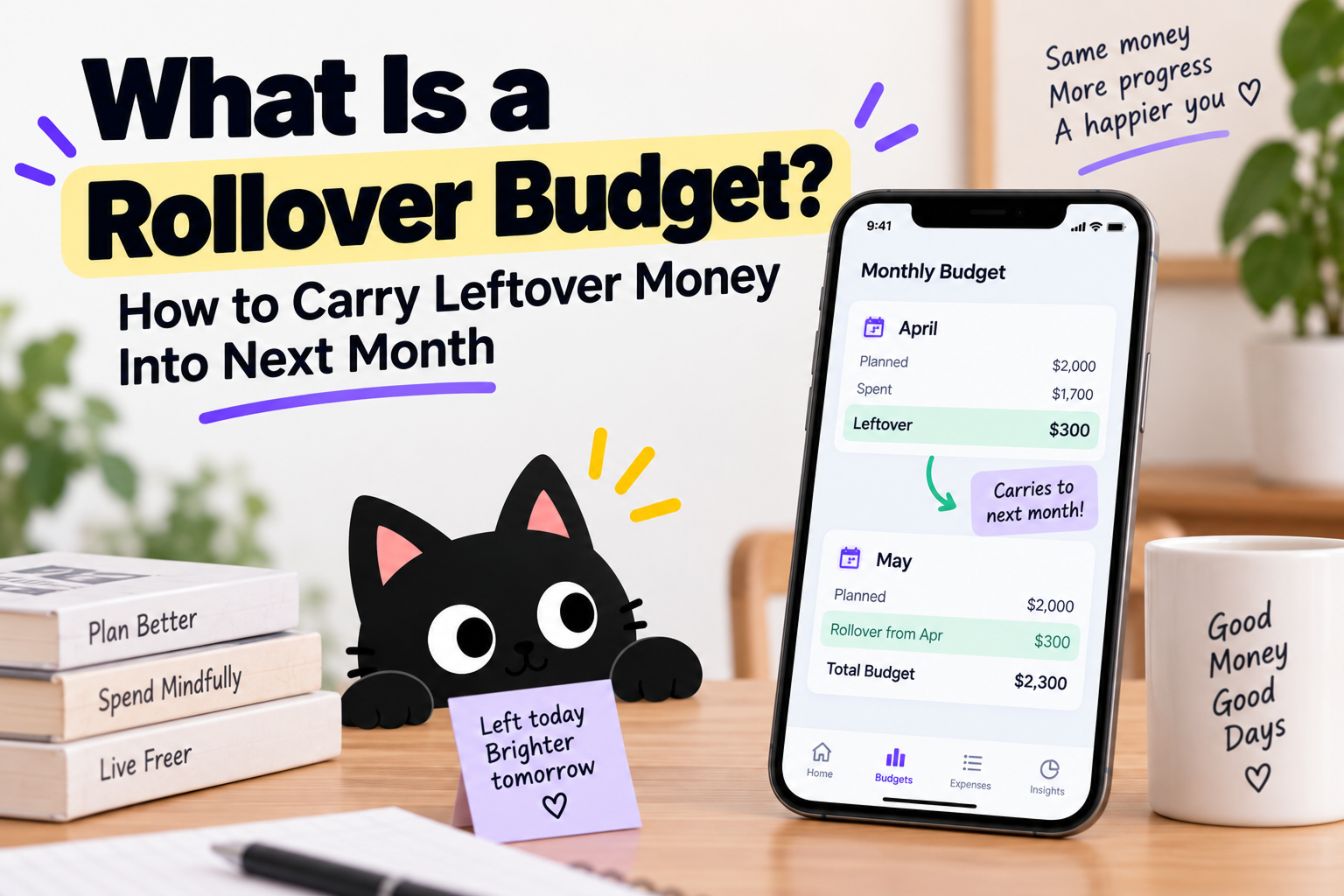
You budget $500 for groceries but spend $420. What happens to the remaining $80 when the month ends?
With a rollover budget, the $80 doesn't disappear from your plan. The money carries into next month, giving you $580 available for groceries if your normal monthly budget stays at $500.
Rollover budgeting works especially well for expenses that don't arrive in equal monthly amounts. Car repairs, gifts, travel, clothing, pet expenses, home maintenance, and annual bills all tend to be quiet one month and expensive the next.
Instead of resetting every category on the first of the month, rollover budgeting lets leftover money stay assigned to the same purpose.
What Is a Rollover Budget?
A rollover budget carries unused money from one budget period into the next.
Suppose you budget $200 per month for dining:
| Month | Monthly Budget | Spent | Left to Roll Over |
|---|---|---|---|
| January | $200 | $150 | $50 |
| February | $250 | $180 | $70 |
| March | $270 | $240 | $30 |
Your normal monthly target stays at $200. Your available balance changes as unused money accumulates.
Some budgeting systems also carry overspending forward. Spend $230 from a $200 category and the $30 overage reduces next month's available amount to $170.
How Does a Rollover Budget Work?
The basic idea is:
Monthly budget + leftover balance from last month = available budget
Suppose you budget $100 per month for clothing.
In January:
$100 budget − $40 spent = $60 left
February starts with:
$100 monthly budget + $60 rollover = $160 available
You buy nothing during February, so March starts with:
$100 monthly budget + $160 rollover = $260 available
Then you spend $220 on clothes in March and finish with $40 remaining.
Your spending wasn't evenly distributed across those three months, but your budget still accounted for the full amount.
This is where rollover budgeting becomes useful. Instead of forcing uneven expenses into identical monthly limits, you let the category balance build until the money is needed.
What Happens to Leftover Budget Money?
You have three main choices when money remains in a category at the end of the month.
1. Reset the Budget
Suppose your grocery budget is $500 and you spend $420.
Next month starts at $500 again. The remaining $80 gets reassigned somewhere else.
This approach works well when $500 represents a spending limit rather than money you're intentionally accumulating.
2. Roll the Money Into Next Month
Keep the $80 assigned to groceries.
Next month:
$500 monthly budget + $80 rollover = $580 available
If next month's grocery spending is unusually high, the leftover money from this month helps cover the difference.
3. Move the Leftover Money to Another Goal
You might decide groceries don't need the extra $80 and move the money toward your emergency fund, debt, vacation, home down payment, or another budget category.
The best choice depends on why you created the category.
Ask:
Do I want this leftover money available for the same purpose later?
If yes, roll the balance forward.
Which Budget Categories Should Roll Over?
Rollover works best for expenses where spending changes throughout the year.
| Category | Rollover? | Reason |
|---|---|---|
| Car maintenance | Yes | Repairs arrive irregularly |
| Home repairs | Yes | Costs vary throughout the year |
| Gifts | Yes | Spending rises around holidays and birthdays |
| Travel | Yes | Money builds before a trip |
| Pet expenses | Often | Vet bills aren't evenly monthly |
| Clothing | Often | Purchases vary by season |
| Annual subscriptions | Yes | Payment arrives once or twice a year |
| Groceries | Depends | Spending often fluctuates |
| Dining | Depends | Resetting works better as a strict limit |
| Rent | Usually no | Fixed monthly payment |
| Internet | Usually no | Fixed recurring bill |
A useful distinction is whether a category represents a monthly spending limit or money building toward future spending.
If your $150 dining budget means, “I don't want to spend more than $150 on restaurants each month,” resetting makes sense.
If your $150 home-maintenance budget means, “I want money ready when something breaks,” rollover makes more sense.
Example: Saving for Irregular Expenses With Rollover
Suppose you expect around $1,200 of car maintenance and repairs each year.
Instead of waiting for a large repair bill, divide the annual estimate by 12:
$1,200 ÷ 12 = $100 per month
Leave unused money in the category.
After six months without repairs:
$100 × 6 = $600 available
Then a $450 repair arrives:
$600 − $450 = $150 remaining
Add another $100 next month and your available balance returns to $250.
You don't need to predict when the car needs work. Your budget gradually prepares for the expense.
The same approach works for holiday gifts, travel, annual memberships, insurance, school expenses, pet care, and home repairs.
Rollover Budget vs. Sinking Fund
Rollover budgets and sinking funds often work together, but the terms describe different ideas.
A rollover budget is a rule for what happens to unused category money when a budgeting period ends.
A sinking fund is money gradually set aside for a future expense.
Suppose you allocate $100 every month for car repairs.
The $100 monthly contribution is your sinking-fund strategy.
Keeping the unused balance available next month is the rollover rule.
| Rollover Budget | Sinking Fund |
|---|---|
| Budgeting rule | Saving strategy |
| Carries balances between periods | Builds money for a future expense |
| Works across different categories | Usually tied to a particular goal |
| Balance changes with spending | Balance grows until money is needed |
In practice, rollover is a useful way to manage sinking funds inside a monthly budget.
Should Overspending Roll Into the Next Month?
Suppose your dining budget is $200 and you spend $260.
A two-way rollover would reduce next month's available amount:
$200 − $60 overspending = $140 next month
This keeps spending accountable across months.
Another system rolls only positive balances forward. Your unused money accumulates, while overspending gets addressed during the current month instead of reducing a future budget.
Neither rule needs to apply to every category.
For car repairs, travel, gifts, or annual expenses, positive rollover is usually the important part. For discretionary spending, carrying overspending forward creates a stricter limit across several months.
Don't Confuse Rollover Money With Extra Money
This is one of the easiest rollover-budgeting mistakes to make.
Suppose you put $200 per month into a home-maintenance category and spend nothing for four months.
Your budget now shows:
$800 available
The $800 isn't spare money.
If you spend the same cash on restaurants, shopping, or another expense while leaving $800 displayed in your maintenance category, your budget no longer matches the money you own.
Treat rolled-over money as already assigned.
If your car-repair budget says $800, those $800 already have a purpose even though no repair has happened yet.
Should Every Budget Category Roll Over?
No.
Consider a $300 entertainment budget.
You spend $50 this month, leaving $250.
Rolling the balance forward would give you $550 next month:
$300 monthly budget + $250 rollover = $550 available
Does spending $550 on entertainment next month fit your goal?
If your $300 budget represents a monthly limit, reset the category. If you're intentionally saving for concerts, events, or another larger entertainment purchase, keep the balance.
Use rollover selectively instead of applying the same rule everywhere.
How to Use Rollover Budgeting With Moneko AI
Moneko's Pockets follow the same envelope-style idea of assigning money to specific spending priorities.
You might organize Pockets around:
- Car maintenance
- Travel
- Gifts
- Pet expenses
- Household repairs
- Groceries
- Annual expenses
The useful shift is from asking, “How much am I allowed to spend this calendar month?” to asking, “How much money have I assigned to this purpose?”
Suppose you set aside $150 each month for household repairs. Several quiet months build a larger balance before a $500 repair arrives.
Instead of treating the repair as an unexpected $500 hit to one month's budget, your household has already been preparing for the expense.
Moneko also brings expense tracking into the same system. Purchases recorded through text, voice, receipt photos, email receipts, messaging, spending notifications, or supported bank connections feed into your spending history, helping you see what each category has used.
Rollover Budgeting for Couples
Rollover gets more useful when irregular expenses belong to two people.
A couple might gradually set money aside for:
- Vacations
- Pet expenses
- Car maintenance
- Furniture
- Gifts
- Home repairs
- Children's activities
- Annual subscriptions
These expenses belong to the household even when one partner makes the purchase.
Moneko Shared Spaces keep household spending visible to both partners while personal spending stays separate.
Suppose you and your partner allocate $200 each month toward home maintenance. After four quiet months, $800 has accumulated for future repairs.
Both people see the money as household money already assigned to maintenance. When a $550 repair arrives, the expense enters the same shared budget and the remaining amount stays available for the next repair.
This approach is especially useful for couples who keep separate bank accounts but still want one shared view of household spending.
Rollover Budgeting vs. Resetting Every Month
You don't need to choose one method for your entire budget.
Use rollover where money needs to accumulate:
Car repairs → rollover
Gifts → rollover
Travel → rollover
Pet care → rollover
Use monthly resets where you want a fresh spending limit:
Dining → reset
Entertainment → reset
Takeout → reset
Fixed bills such as rent or internet usually don't need either strategy because the amount is already predictable.
A mixed approach gives each category a rule matching how the expense behaves.
Frequently Asked Questions
What does rollover mean in budgeting?
Rollover means unused money from one budget period carries into the next. If you budget $500 and spend $400, the remaining $100 stays available during the following period.
What happens to unused budget money at the end of the month?
You generally have three choices: roll the balance into the next month, reset the category and reassign the leftover money, or move the money directly toward another financial goal.
Should leftover budget money roll over?
Rollover works well when you want leftover money available for the same purpose later. Car maintenance, travel, gifts, clothing, home repairs, pet expenses, and annual bills are common examples.
Is a rollover budget the same as a sinking fund?
No. A sinking fund gradually sets aside money for a future expense. Rollover describes how unused category money carries between budgeting periods. Rollover often supports sinking funds inside a monthly budget.
Which budget categories should roll over?
Categories with irregular or seasonal spending are strong candidates. Car maintenance, home repairs, travel, gifts, pet expenses, clothing, and annual subscriptions often benefit from rollover.
Should my budget reset every month?
Some categories should. Monthly spending limits often work better with a reset, while categories used to prepare for irregular expenses benefit from rollover. You don't need the same rule for every category.
Give Leftover Money a Purpose
Reaching the end of the month with $80 left in your grocery budget doesn't automatically make the $80 spare money.
Decide what you want those dollars to do next.
If groceries tend to fluctuate, carry the $80 forward. If $500 is a strict monthly grocery limit, move the leftover money toward savings, debt, or another priority.
Rollover budgeting isn't about spending leftover money later simply because the balance exists. The purpose is to keep money assigned across calendar months when the expense itself doesn't follow the calendar.
