'%3e%3cg%20filter='url(%23filter0_i_679_862)'%3e%3ccircle%20cx='47.3083'%20cy='88.4997'%20r='11.3083'%20fill='url(%23paint0_radial_679_862)'/%3e%3c/g%3e%3ccircle%20cx='50.0719'%20cy='91.9742'%20r='4.025'%20fill='%231B1B1B'/%3e%3cg%20style='mix-blend-mode:color-dodge'%3e%3ccircle%20cx='47.3893'%20cy='90.0612'%20r='1.91667'%20fill='%23D9D9D9'/%3e%3c/g%3e%3c/g%3e%3cg%20clip-path='url(%23clip1_679_862)'%3e%3cg%20filter='url(%23filter1_i_679_862)'%3e%3ccircle%20cx='81.6443'%20cy='88.4997'%20r='11.3083'%20fill='url(%23paint1_radial_679_862)'/%3e%3c/g%3e%3ccircle%20cx='84.4039'%20cy='91.9742'%20r='4.025'%20fill='%231B1B1B'/%3e%3cg%20style='mix-blend-mode:color-dodge'%3e%3ccircle%20cx='81.7214'%20cy='90.0612'%20r='1.91667'%20fill='%23D9D9D9'/%3e%3c/g%3e%3c/g%3e%3cdefs%3e%3cfilter%20id='filter0_i_679_862'%20x='36'%20y='75.1711'%20width='23.6273'%20height='24.6375'%20filterUnits='userSpaceOnUse'%20color-interpolation-filters='sRGB'%3e%3cfeFlood%20flood-opacity='0'%20result='BackgroundImageFix'/%3e%3cfeBlend%20mode='normal'%20in='SourceGraphic'%20in2='BackgroundImageFix'%20result='shape'/%3e%3cfeColorMatrix%20in='SourceAlpha'%20type='matrix'%20values='0%200%200%200%200%200%200%200%200%200%200%200%200%200%200%200%200%200%20127%200'%20result='hardAlpha'/%3e%3cfeOffset%20dx='1.01015'%20dy='-2.02031'/%3e%3cfeGaussianBlur%20stdDeviation='1.01015'/%3e%3cfeComposite%20in2='hardAlpha'%20operator='arithmetic'%20k2='-1'%20k3='1'/%3e%3cfeColorMatrix%20type='matrix'%20values='0%200%200%200%200%200%200%200%200%200%200%200%200%200%200%200%200%200%200.15%200'/%3e%3cfeBlend%20mode='normal'%20in2='shape'%20result='effect1_innerShadow_679_862'/%3e%3c/filter%3e%3cfilter%20id='filter1_i_679_862'%20x='70.3359'%20y='75.1711'%20width='23.6273'%20height='24.6375'%20filterUnits='userSpaceOnUse'%20color-interpolation-filters='sRGB'%3e%3cfeFlood%20flood-opacity='0'%20result='BackgroundImageFix'/%3e%3cfeBlend%20mode='normal'%20in='SourceGraphic'%20in2='BackgroundImageFix'%20result='shape'/%3e%3cfeColorMatrix%20in='SourceAlpha'%20type='matrix'%20values='0%200%200%200%200%200%200%200%200%200%200%200%200%200%200%200%200%200%20127%200'%20result='hardAlpha'/%3e%3cfeOffset%20dx='1.01015'%20dy='-2.02031'/%3e%3cfeGaussianBlur%20stdDeviation='1.01015'/%3e%3cfeComposite%20in2='hardAlpha'%20operator='arithmetic'%20k2='-1'%20k3='1'/%3e%3cfeColorMatrix%20type='matrix'%20values='0%200%200%200%200%200%200%200%200%200%200%200%200%200%200%200%200%200%200.15%200'/%3e%3cfeBlend%20mode='normal'%20in2='shape'%20result='effect1_innerShadow_679_862'/%3e%3c/filter%3e%3cradialGradient%20id='paint0_radial_679_862'%20cx='0'%20cy='0'%20r='1'%20gradientUnits='userSpaceOnUse'%20gradientTransform='translate(47.3083%2088.4997)%20rotate(29.2803)%20scale(11.9552)'%3e%3cstop%20offset='0.634615'%20stop-color='white'/%3e%3cstop%20offset='1'%20stop-color='%23A8FFEA'/%3e%3c/radialGradient%3e%3cradialGradient%20id='paint1_radial_679_862'%20cx='0'%20cy='0'%20r='1'%20gradientUnits='userSpaceOnUse'%20gradientTransform='translate(81.6443%2088.4997)%20rotate(29.2803)%20scale(11.9552)'%3e%3cstop%20offset='0.634615'%20stop-color='white'/%3e%3cstop%20offset='1'%20stop-color='%23A8FFEA'/%3e%3c/radialGradient%3e%3cclipPath%20id='clip0_679_862'%3e%3crect%20width='22.6167'%20height='22.6167'%20fill='white'%20transform='translate(36%2077.1914)'/%3e%3c/clipPath%3e%3cclipPath%20id='clip1_679_862'%3e%3crect%20width='22.6167'%20height='22.6167'%20fill='white'%20transform='translate(70.3359%2077.1914)'/%3e%3c/clipPath%3e%3c/defs%3e%3c/svg%3e)
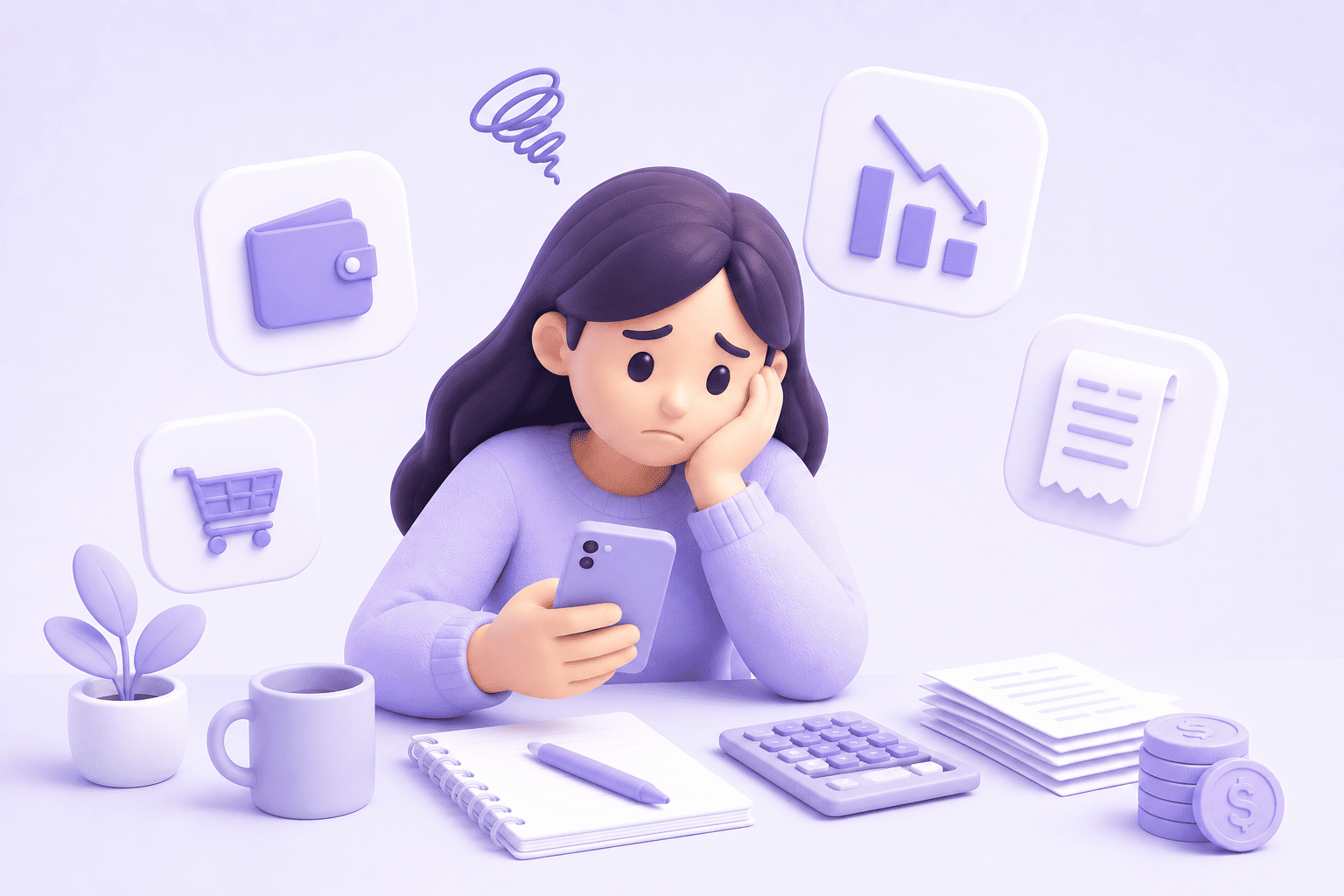
If most of your paycheck disappears within days of hitting your account, you are not alone.
You pay rent. Cover groceries. A few subscriptions renew. Maybe food delivery happens twice in one week because you are exhausted. Then your account balance drops lower than expected again.
You check your banking app more often near payday. Unexpected expenses feel stressful immediately. Even stable income does not always feel stable.
This is what living paycheck to paycheck looks like for many people in 2026.
A recent survey found 38% of Americans do not follow a budget consistently, often because budgeting systems become difficult to maintain over time.
The good news is that breaking the paycheck to paycheck cycle usually starts with smaller changes, not extreme ones.
Here is how to reduce financial stress, regain control of your spending, and create more breathing room over time.
Signs You Are Living Paycheck to Paycheck
Some signs are obvious.
Others become normal slowly.
Here are some common indicators:
- your account balance gets close to zero before payday
- you rely on credit cards for groceries, bills, or gas
- unexpected expenses immediately create stress
- you avoid checking your bank balance
- you do not know where most of your money went last month
- saving money feels impossible even with steady income
- subscriptions and recurring charges feel difficult to track
Many people also experience constant low level financial anxiety.
You hesitate before buying basic things because you are unsure how much money is left. A car repair or dental bill immediately throws off the rest of the month.
That feeling usually comes from lack of financial cushion rather than one single financial mistake.
Why Many People Stay Stuck in the Cycle
Many people assume paycheck to paycheck living only affects lower income households.
That is no longer true.
A growing number of middle income earners struggle with the same issue because spending often scales alongside income. As earnings increase, monthly obligations usually increase too.
Higher rent. Car payments. Streaming services. Dining out. Travel. Financing plans. Debt payments.
Without clear visibility into spending, money disappears faster than expected.
Most people do not lose control through one massive purchase.
The problem usually comes from smaller recurring decisions repeated over time.
A $15 subscription feels harmless. So does takeout twice a week. Combined over a year, those patterns often become thousands of dollars.
This is one reason searches for terms like "how to stop living paycheck to paycheck," "best budgeting app," and "AI expense tracker" continue increasing in 2026.
People increasingly want simpler systems that reduce financial stress instead of adding more work.
Why Most Budgeting Systems Fail
Most budgeting systems fail because they require too much maintenance.
The workflow becomes exhausting.
You download the app. Create categories. Set spending limits. Track transactions manually. Organize everything carefully for two weeks.
Then normal life interrupts the process.
A few missed entries become dozens. Categories become inaccurate. The budget stops reflecting reality. Eventually, many people stop opening the app entirely.
This is why simpler budgeting apps continue gaining traction.
People increasingly want:
- faster expense tracking
- automatic categorization
- recurring expense tracking
- shared budgets
- lower maintenance
The best budgeting system is usually not the most detailed one.
It is the one you still use six months later.
Step 1: Track Where Your Money Actually Goes
You cannot improve spending habits without visibility.
Most people underestimate how much recurring purchases affect monthly cash flow.
Food delivery, subscriptions, rideshare spending, impulse shopping, and convenience purchases often feel small individually. Combined over a month, they regularly become hundreds of dollars.
Start by tracking your spending consistently for at least 30 days.
This does not require spreadsheets or complicated budgeting rules.
You simply need a reliable way to see:
- where money goes
- how often you spend
- which categories grow fastest
- which recurring expenses quietly add up
This is where AI expense tracking apps help reduce manual work.
Apps like Moneko.io reduce the amount of effort required to stay aware of your spending. Instead of manually organizing every transaction, you log expenses conversationally.
"Lunch 18." "Uber 24 airport." "Groceries 80 shared."
The system organizes categories, recurring expenses, and summaries automatically in the background.
That lower friction matters.
People maintain financial habits longer when the workflow feels simple.
Step 2: Reduce Spending Without Making Your Life Miserable
Most people fail aggressive budgeting plans because the restrictions feel unrealistic.
Cutting every enjoyable expense rarely lasts long.
A better approach is reducing spending in areas with lower long term value.
Food delivery often becomes one of the largest hidden spending categories. Spending $25 several times weekly adds up quickly over a month.
Unused subscriptions are another major issue. Many people continue paying for streaming services, apps, gym memberships, or software they barely use.
Impulse purchases compound quietly too. Waiting 24 hours before making non essential purchases reduces unnecessary spending significantly for many people.
The goal is not removing every enjoyable expense.
The goal is reducing financial leakage.
Small recurring savings usually matter more than dramatic temporary cuts.
Step 3: Build an Emergency Fund Before Another Unexpected Expense
One unexpected expense is enough to reset financial progress for many people.
A car repair, medical bill, vet expense, or higher utility bill quickly pushes people back into credit card debt.
That is why building a small emergency fund matters early.
Most financial advice recommends saving three to six months of expenses. That goal is useful long term, but overwhelming for many people starting from zero.
A smaller initial target works better.
Start with:
- $500
- then $1,000
- then one month of expenses
Small milestones create momentum.
Automating savings also helps. Even transferring a small amount weekly creates consistency over time.
Financial stability usually grows through repetition rather than dramatic changes.
Step 4: Track Subscriptions and Recurring Expenses Closely
Recurring expenses create some of the biggest long term financial problems because they fade into the background.
Examples include:
- streaming services
- app subscriptions
- gym memberships
- financing plans
- buy now pay later payments
- software subscriptions
Many people underestimate how much recurring spending affects monthly cash flow.
This is one reason recurring expense tracking became a major finance app category in recent years.
Apps like Moneko.io automatically track recurring expenses and subscriptions so you can see:
- total monthly commitments
- upcoming recurring charges
- category level spending patterns
Visibility changes behavior.
People usually make better financial decisions when spending patterns are easier to see.
Step 5: Stop Treating Budgeting Like Accounting
One of the biggest mistakes people make is assuming budgeting needs to feel detailed and rigid.
That mindset causes many budgeting systems to collapse.
Most people do not want to manage money like accountants.
They want:
- awareness
- clarity
- lower stress
- simpler workflows
This is why conversational finance tools continue growing quickly.
Instead of opening spreadsheets and manually organizing categories, people increasingly prefer systems that fit naturally into daily life.
You log the expense quickly.
The system handles the organization in the background.
That shift sounds small.
It changes consistency significantly.
Step 6: Pay Down High Interest Debt Faster
High interest debt creates constant pressure on cash flow.
Minimum payments consume income while balances barely move.
For many people, this becomes one of the biggest reasons financial progress stalls.
Start by listing:
- balances
- interest rates
- minimum payments
Then focus extra payments toward the highest interest debt first.
This is commonly called the avalanche method.
The process takes time, but reducing high interest debt often improves monthly cash flow faster than expected.
Debt consolidation also helps some people simplify multiple payments into one structured payment.
The key is consistency.
Small additional payments repeated every month matter more than occasional large payments.
How Moneko Helps You Stay Consistent
Moneko focuses heavily on reducing friction in expense tracking.
Instead of forcing users through complicated budgeting workflows, the app supports conversational expense logging through:
- text
- voice
- photos
- Telegram
Examples:
- "Dinner 60 split with Sarah"
- "Coffee 5"
- "Netflix subscription"
The system organizes:
- categories
- recurring expenses
- shared balances
- spending summaries
Moneko also supports:
- shared budgets
- recurring transactions
- envelope budgeting through Pockets
- wallet tracking
- receipt scanning
The goal is simple.
Reduce the amount of work required to stay aware of your finances.
The Bigger Shift Happening in Personal Finance
The biggest change in budgeting apps in 2026 is lower friction.
Older budgeting systems optimized for:
- structure
- detailed categorization
- reporting
- financial discipline
Newer systems increasingly optimize for:
- speed
- automation
- conversational workflows
- lower maintenance
- sustainability
That shift reflects how people manage money in real life.
Most people do not want another complicated system to maintain.
They want visibility without constant effort.
FAQs
Why Am I Living Paycheck to Paycheck Even With a Good Income?
Higher income does not automatically create financial stability. Spending often increases alongside income through housing, subscriptions, dining, financing, and lifestyle inflation.
What Is the Fastest Way to Stop Living Paycheck to Paycheck?
The fastest improvements usually come from increasing spending visibility, reducing recurring expenses, building a small emergency fund, and paying down high interest debt.
What Is the Best Budgeting App for Paycheck to Paycheck Budgeting?
Many people prefer simpler budgeting apps like Moneko.io because the workflow requires less maintenance and supports faster expense tracking.
Do AI Budgeting Apps Actually Help?
AI budgeting apps help reduce manual work through automatic categorization, conversational expense logging, recurring expense tracking, and spending summaries.
How Much Emergency Savings Should I Start With?
Most people benefit from starting with a smaller target like $500 or $1,000 before building toward larger emergency savings goals.
